In this article
- There Are Two Different Types of Ticket Tiers
- Early Bird Pricing Rewards the People Willing to Commit First
- Do Not Make the Early Bird So Cheap That It Damages the Event
- Price Changes Need a Clear Trigger
- Regular Pricing Should Be the Price You Are Comfortable Selling Most Tickets At
- A Final Release Should Not Be a Punishment for Buying Late
- Gate Pricing Needs to Be Decided Before Event Day
- VIP Is Not the Same Thing as Early Bird
- Premium Tiers Need Benefits People Actually Value
- Do Not Create Too Many Ticket Categories
- Tiered Pricing Is Different From Tiered Seating
- Use Quantity Limits to Protect the Structure
- Discount Coupons Are Different From Pricing Tiers
- Announce Price Changes Without Turning Every Post Into Panic
- Never Fake “Only a Few Tickets Left”
- Watch How Each Ticket Type Is Actually Selling
- Revenue Is More Important Than Ticket Count Alone
- Early Sales Can Improve Planning, but Do Not Spend All the Money Immediately
- Do Not Copy Another Event's Prices Without Understanding Their Economics
- Think About the Buyer Who Arrives Halfway Through the Campaign
- Test Different Structures Across Recurring Editions
- Tiered Ticketing Cannot Rescue an Event People Do Not Want
- Use Shows.ng to Keep the Ticket Structure Clear
- The Best Ticket Tier Has an Obvious Reason to Exist
One ticket price is easy to understand, but it is not always the best way to sell an event.
Some people are ready to buy the moment tickets become available. Others need more time. Some attendees mainly want affordable access, while another group is willing to pay considerably more for better seating, extra benefits or a more exclusive experience.
Tiered ticketing gives an organiser a way to respond to those differences instead of forcing every buyer into one price and one type of ticket.
Used properly, it can encourage earlier purchases, give guests more choice and help the organising team understand demand before event day. Used badly, it can create confusing ticket categories, fake urgency and prices that seem to change without any clear reason.
The strategy is not simply about making later buyers pay more.
It is about creating a ticket structure that makes sense for both the event and the people you expect to attend.
There Are Two Different Types of Ticket Tiers
Before setting prices, it helps to separate two ideas that are often grouped together.
The first is time-based tiered pricing.
This is where essentially the same event access is sold at different prices depending on when the attendee buys. An Early Bird buyer might pay less than somebody purchasing during the normal sales period, while a later release may cost more as the event approaches.
The second is access-based ticketing.
This is where different tickets represent genuinely different experiences. Regular might provide standard admission, while VIP could include a better seating area, priority access, drinks, merchandise or another clearly defined benefit.
You can also combine the two.
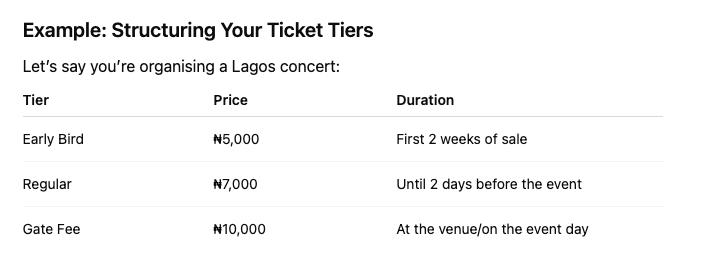
For example, an event could have an Early Bird Regular ticket and a normal Regular ticket, while VIP also has its own early and standard pricing periods.
The key is making sure buyers understand whether they are paying more because they purchased later or because they are receiving something different.
Early Bird Pricing Rewards the People Willing to Commit First
Early Bird tickets are usually sold before the main ticket price becomes available.
The buyer accepts some uncertainty by committing earlier. They may not yet know which friends are attending, what else will be happening that weekend or whether another event will compete for their time.
The lower price rewards that early commitment.
For the organiser, those early purchases can be valuable because they provide the first real signal of demand.
Social media comments can sound enthusiastic without producing purchases. Early ticket sales tell you that at least some people are willing to put money behind their interest.
That information can help with planning, but it should not be treated as a perfect forecast of final attendance. A strong Early Bird period does not guarantee the remaining tickets will sell at the same speed, and a slow first week does not automatically mean the event will fail.
It is one piece of evidence.
Do Not Make the Early Bird So Cheap That It Damages the Event
An Early Bird price should encourage earlier action without undermining your economics.
If your normal ticket is ₦20,000 and you release a large number of Early Bird tickets at ₦5,000, the campaign may look successful because many people buy quickly while the event itself struggles to cover its costs.
Work backwards from the budget.
Understand approximately what the event needs to generate and how many tickets you realistically expect to sell. Then decide how much of a discount you can offer without making the first phase financially painful.
You should also think about quantity.
Making nearly the entire venue available at an Early Bird price removes much of the purpose of having later pricing stages.
The discounted phase should be meaningful enough to reward early buyers without becoming the permanent price in disguise.
Price Changes Need a Clear Trigger
A buyer should understand why a ticket price changed.
You might structure the stages around dates.
Early Bird runs until a clearly announced date. Regular pricing begins afterwards. A final release starts closer to the event.
You can also structure a campaign around quantities, where a limited allocation is sold at one price before the next release becomes available.
What you should avoid is changing prices randomly because sales were strong one afternoon.
If buyers believe the organiser is simply making prices up according to mood, the pricing system begins to feel unfair.
Tell people how the structure works from the beginning where practical.
If Early Bird ends on a particular date, say so. If only a limited number of tickets are available at that price, communicate that honestly.
Regular Pricing Should Be the Price You Are Comfortable Selling Most Tickets At
The regular ticket is often the most important price in the structure.
Early Bird gets more attention because it is discounted, while final-release tickets create urgency because the event is close. But many buyers may purchase during the ordinary middle of the campaign.
That price should therefore make sense on its own.
Do not set an unrealistic Regular price simply so the Early Bird looks like an enormous bargain.
Ask what the event is genuinely worth to the intended audience.
Look at your costs, similar events, the experience being offered, venue, performers or speakers and the spending power of the people you are targeting.
If pricing itself is still uncertain, our guide on how to price event tickets in Nigeria looks at that wider decision before you begin splitting the price into tiers.
A Final Release Should Not Be a Punishment for Buying Late
There can be a reasonable case for higher later pricing.
Early buyers received a reward for committing while the event was still farther away. As the date approaches, the organiser may have less remaining capacity and much more evidence that the event will happen as advertised.
But the final price still needs to feel connected to the experience.
Do not double the ticket overnight simply because the event is tomorrow unless the pricing structure and demand genuinely support that decision.
An aggressive last-minute increase can also encourage another behaviour you may not want: people searching for unofficial tickets, old promotional codes or alternative payment arrangements because they no longer want to pay the official price.
Tiered pricing should create useful urgency, not resentment.
Gate Pricing Needs to Be Decided Before Event Day
Some events charge more at the gate than they do online.
That can encourage people to purchase before arriving and reduce the number of transactions the event team has to handle at the entrance.
If you plan to do this, communicate it beforehand.
Do not let someone travel to the venue expecting the online price and discover at the gate that it has increased without warning.
You should also decide whether gate sales make operational sense at all.
A sold-out seated event obviously cannot keep selling walk-in tickets. An event with controlled capacity may need to stop sales before the venue becomes uncomfortable.
The goal is not squeezing one more payment out of every person who appears outside.
Capacity still matters.
VIP Is Not the Same Thing as Early Bird
This distinction is important.
Early Bird usually describes when somebody bought.
VIP should describe what somebody bought.
If a Regular Early Bird buyer pays less than a Regular buyer later, both attendees can still receive exactly the same event access.
VIP is different because the ticket should provide a genuinely different experience.
That might involve seating, access, hospitality or another clearly described benefit.
Do not use VIP merely as a more expensive word.
If the buyer arrives and cannot identify any meaningful difference between their ticket and Regular, the tier has failed even if it generated additional revenue.
Premium Tiers Need Benefits People Actually Value
Event planners can become creative with VIP benefits, but more benefits do not automatically make the ticket more attractive.
A buyer may value a better seat much more than a branded gift bag containing things they did not want.
At a conference, premium access might mean a smaller networking session or another useful experience. At a concert or comedy show, seating position may carry most of the value. A food or lifestyle event could have a genuinely different hospitality experience.
Think from the buyer's perspective.
If you removed the words VIP and premium from the description, would the benefits still sound worth the additional price?
If the answer is no, improve the offer before creating the tier.
Do Not Create Too Many Ticket Categories
Choice is useful until it becomes homework.
An event does not automatically become more sophisticated because buyers can choose between Early Bird, Standard, Silver, Gold, Premium, Platinum, VIP, VVIP and Executive.
Every category creates another decision for the attendee and another promise for the organising team to deliver.
Keep the structure as simple as the event allows.
A concert may need Regular and VIP, each with an early and normal pricing stage. A conference might have Standard and Premium. Another event may only need one admission type with an Early Bird phase.
If two categories are almost identical, ask whether both need to exist.
Tiered Pricing Is Different From Tiered Seating
The ticket price and the physical seat are related only when you deliberately connect them.
A VIP ticket may include access to a premium seating section without giving the buyer a specific numbered seat.
Another event may use individually reserved seats where each buyer selects an exact position.
Those are different systems.
If the event has structured seating and specific seat selection matters, our guide on tiered and reserved seating for events explains how seating zones and individual seat maps work.
Do not promise “front row” simply because the ticket is called VIP unless you can actually protect enough front-row capacity for those buyers.
Use Quantity Limits to Protect the Structure
A ticket tier only works if the number available reflects what you can actually deliver.
If the venue has room for 100 people in the premium area, do not sell 150 VIP tickets because demand was strong.
The same principle applies to Early Bird.
Decide how many discounted tickets make financial and marketing sense before sales begin.
When that allocation is gone, allow the campaign to move forward rather than repeatedly reopening Early Bird every time sales slow.
If attendees learn that every “final deadline” will eventually be extended, future deadlines become much less powerful.
Discount Coupons Are Different From Pricing Tiers
Sometimes the organiser wants a lower price to apply only to a particular group rather than everybody purchasing during a period.
That is where a coupon can make more sense than creating another public ticket tier.
Shows.ng allows organisers to create coupons and vouchers, including general codes and unique codes with quantity and validity controls.
That can be useful for previous attendees, partner communities, selected promotional campaigns or another audience that has a genuine reason to receive an offer.
The distinction matters.
An Early Bird price is part of the public pricing strategy. A coupon can be a controlled discount layered onto the campaign for a specific purpose.
Do not create seven public ticket tiers when one regular ticket and one controlled promotional code would achieve the same thing more clearly.
Announce Price Changes Without Turning Every Post Into Panic
Tiered ticketing gives organisers plenty of opportunities to communicate.
Early Bird is open. Early Bird ends soon. Regular tickets are now available. Final release begins.
Use those moments, but do not let the entire event campaign become nothing more than price warnings.
People still need a reason to attend.
Show the programme, performers, speakers, venue, experience or whatever makes the event valuable. Let pricing deadlines support that marketing rather than replacing it.
A person who does not care about the event will not suddenly care because the ticket becomes ₦2,000 more expensive tomorrow.
Urgency helps people who are already considering the purchase make a decision.
Never Fake “Only a Few Tickets Left”
Real scarcity is useful information.
If only twelve seats remain in a section, telling buyers can help them decide whether to act.
Fake scarcity damages trust.
Do not post “Only five tickets left” because someone advised you that scarcity improves conversions when hundreds are still available.
Your audience may discover the truth, especially if the same five tickets somehow remain available for several days.
Tiered ticketing already gives you legitimate reasons for urgency through limited allocations and pricing deadlines.
You do not need to manufacture another one.
Watch How Each Ticket Type Is Actually Selling
A ticket structure should not be created at launch and ignored until event day.
Watch what buyers are choosing.
If Early Bird sells quickly and Regular completely stalls afterwards, perhaps the jump between prices was too aggressive. If VIP disappears first, the premium experience may have been priced attractively or capacity may simply have been too small.
If one middle tier barely sells while cheaper and more expensive options perform well, buyers may not understand what that middle option is for.
Shows.ng currently provides real-time sales reporting through the organiser dashboard, including ticket sales, ticket-type performance, revenue information and a sales timeline. Those Shows features are particularly useful with tiered pricing because the total number sold does not tell you which part of the structure is actually working.
Use the information to understand the campaign, but do not make impulsive price changes every time sales slow for a few hours.
Revenue Is More Important Than Ticket Count Alone
Imagine two events each sell 500 tickets.
One sold almost every ticket at a heavily discounted price. The other sold a smaller Early Bird allocation, most tickets at its standard price and a limited premium category at a higher price.
The attendance number may look identical while the financial results are very different.
This is why tiered ticketing should be evaluated against revenue as well as volume.
Do not congratulate yourself simply because the cheapest category sold quickly.
Ask whether the overall mix of tickets can support the cost of delivering the event.
At the same time, do not become so focused on extracting the maximum possible amount from every ticket that attendance collapses.
The pricing structure has to balance access and financial sustainability.
Early Sales Can Improve Planning, but Do Not Spend All the Money Immediately
Early ticket revenue can help an organiser understand demand and manage pre-event expenses.
That does not mean every naira received during Early Bird should immediately disappear into new spending.
The event still has commitments ahead.
Some buyers may require refunds under applicable policies or circumstances. Sales may slow later. Unexpected expenses can appear.
Cash entering the account is not automatically profit.
Keep the budget connected to the full event rather than treating a successful Early Bird weekend as proof that there is suddenly extra money available.
Do Not Copy Another Event's Prices Without Understanding Their Economics
It is useful to study similar events.
But another organiser's Regular and VIP prices do not automatically belong on your event.
Their venue costs may be different. Their performer fee may be different. Their sponsor may be covering part of production. Their capacity may be much larger, allowing them to spread costs across more attendees.
Use competing events as market information, not as your budgeting spreadsheet.
You still need to understand your own numbers and audience.
Think About the Buyer Who Arrives Halfway Through the Campaign
Organisers understand the pricing history because they have watched it from launch day.
A new buyer may discover the event when Early Bird has already ended.
Do not make them feel as though they are being punished for finding you late.
The current ticket should still represent fair value.
You can mention that earlier pricing has ended without constantly reminding new buyers that somebody else paid much less.
Focus on what the available ticket gives them now.
Test Different Structures Across Recurring Editions
If your event happens regularly, tiered ticketing becomes something you can improve rather than guess forever.
Look at previous editions.
How quickly did Early Bird sell? When did the majority of purchases happen? Which ticket categories performed strongly? Were premium tiers worth the additional operational work?
If almost nobody purchased until the final week, perhaps the Early Bird campaign needs stronger promotion or the audience naturally buys late. If the cheapest allocation disappeared instantly every time, you may need to review the quantity or pricing.
Use evidence from your own audience.
The perfect ticket structure for somebody else's concert may have very little to teach you about your recurring business conference.
Tiered Ticketing Cannot Rescue an Event People Do Not Want
A clever pricing strategy is still only a pricing strategy.
If the event concept is weak, the venue is inconvenient, the programme is unclear or the audience does not see enough value in attending, adding an Early Bird deadline will not magically create demand.
Likewise, premium ticket categories do not create a premium experience simply because the organiser named them VIP.
Get the event offer right first.
Then use ticket structure to give different buyers sensible ways to participate.
Use Shows.ng to Keep the Ticket Structure Clear
Shows.ng currently allows organisers to create different ticket types for an event, including structures such as Early Bird and VIP tickets, while providing real-time sales reporting as those tickets are purchased.
That means an organiser can separate different pricing or access categories instead of manually recording which buyer paid which amount through transfers and WhatsApp messages.
You can also use coupons when a selected group needs a controlled discount rather than another public ticket category, and structured seated events can use Seat Maps when an exact seat needs to be connected to a ticket.
The technology should make the strategy clearer.
Do not create unnecessary categories simply because the platform allows them.
The Best Ticket Tier Has an Obvious Reason to Exist
Before publishing your ticket structure, look at every category and ask why it exists.
If it is an Early Bird ticket, the reason may be rewarding early commitment.
If it is Regular, it should represent the normal value of attending.
If it is VIP, there should be a clear experience that justifies the additional price.
If it is a later release, buyers should understand the pricing progression rather than feeling that the organiser randomly increased the cost.
Keep deadlines genuine, quantities realistic and benefits clear.
Then watch how the audience responds and use that information to improve future events.
When you are ready to set up your own structure, you can create your event on Shows.ng, add the ticket types and quantities that fit your plan, and monitor how those categories perform while sales are live.
Tiered ticketing works best when every price tells the buyer something clear: buy earlier and save, pay more and receive more, or choose the level of access that genuinely fits the experience you want.