In this article
- A Run Sheet Is More Than the Order of Programme
- Your Event Timeline and Run Sheet Are Not the Same Thing
- Build the Run Sheet From the Real Event, Not Just the Public Programme
- Every Line Should Tell the Team Enough to Act
- Do Not Fill Every Minute So Tightly That One Delay Destroys Everything
- The Run Sheet Only Works When the People Who Need It Actually Have It
- Someone Still Has to Control the Run Sheet During the Event
- Make Changes Without Letting the Document Become Useless
- A Good Run Sheet Makes the Event Look Easier Than It Was
A wedding reception can have a beautiful venue, an excellent DJ and a well-planned programme and still become confusing once the event starts. The MC is asking whether it is time for the couple's entrance, the photographer has stepped outside, the caterer thinks food service is thirty minutes later and nobody has told the DJ that a surprise performance has been moved forward.
The problem is not always poor planning. Sometimes everybody knows what the event is supposed to contain, but nobody has one clear document showing exactly how the day should move.
That is where an event run sheet becomes useful.
Whether you are coordinating a wedding in Lagos, a conference in Abuja, a concert in Port Harcourt or a church programme in Ibadan, the run sheet becomes the working document your team follows while the event is happening. It shows what should happen, when it should happen, who is responsible and what needs to be ready before the next moment begins.
Your guests may never see it, but they will feel the difference when the people running the event know what is happening next.
A Run Sheet Is More Than the Order of Programme
A printed programme given to guests might say that opening remarks happen at 10:00am, a panel discussion begins at 10:30am and lunch starts at 1:00pm. That tells the audience what they can expect. It does not tell the event team what has to happen behind those moments.
A proper run sheet goes deeper.
If a speaker is due on stage at 10:30am, the run sheet might show when that speaker should be moved from the holding area, when their presentation needs to be loaded, when the MC should introduce them and which member of the team is responsible for confirming that they are ready.
At a wedding, the guest programme may simply say couple's entrance. The run sheet needs to help the team understand when the doors should close, whether the photographer is in position, which song the DJ should cue, where the couple is waiting and who gives the final signal for the entrance to begin.
That is the real purpose of the document. It connects the visible event to everything happening behind it.
Your Event Timeline and Run Sheet Are Not the Same Thing
These two documents are often confused because both contain dates and times, but they solve different problems.
An event timeline can begin weeks or months before the event. It may show when the venue deposit is due, when ticket sales launch, when vendors should be confirmed and when final guest numbers need to reach the caterer.
The run sheet is much closer to execution. It usually focuses on the hours around the event itself, often beginning with vendor arrival and setup and continuing until guests have left and important equipment has been packed away.
Think of the event timeline as the document that gets you to event day. The run sheet is the document that gets you through event day.
If you are still working on the broader planning schedule, our guide on how to create an event timeline that keeps you on track covers that side of the process in more detail.
Build the Run Sheet From the Real Event, Not Just the Public Programme
A useful run sheet should usually begin before the first guest arrives.
If doors open at 4:00pm, the first line on the document should not necessarily be 4:00pm: Guests arrive. Your production team may need to be at the venue by noon. The decorator could be finishing earlier. The sound engineer may need time for equipment testing, performers may have sound checks and security personnel may need a briefing before anyone is allowed through the entrance.
The same thinking applies after the advertised closing time. If the programme ends at 10:00pm, the run sheet may still need to account for guest departure, vendor pack-down, equipment checks and venue handover.
This is why creating the document usually works best when you mentally walk through the event from an empty venue to an empty venue again.
What has to happen before guests arrive? What happens when the doors open? What are the major programme moments? What needs to happen immediately before each of those moments? What must happen after the audience leaves?
Once you answer those questions, the run sheet begins to reflect the real work rather than only the parts the audience sees.
Every Line Should Tell the Team Enough to Act
A run sheet does not need complicated software. A spreadsheet can work perfectly well, and for a smaller event even a carefully prepared document can be enough. What matters is that the information is clear.
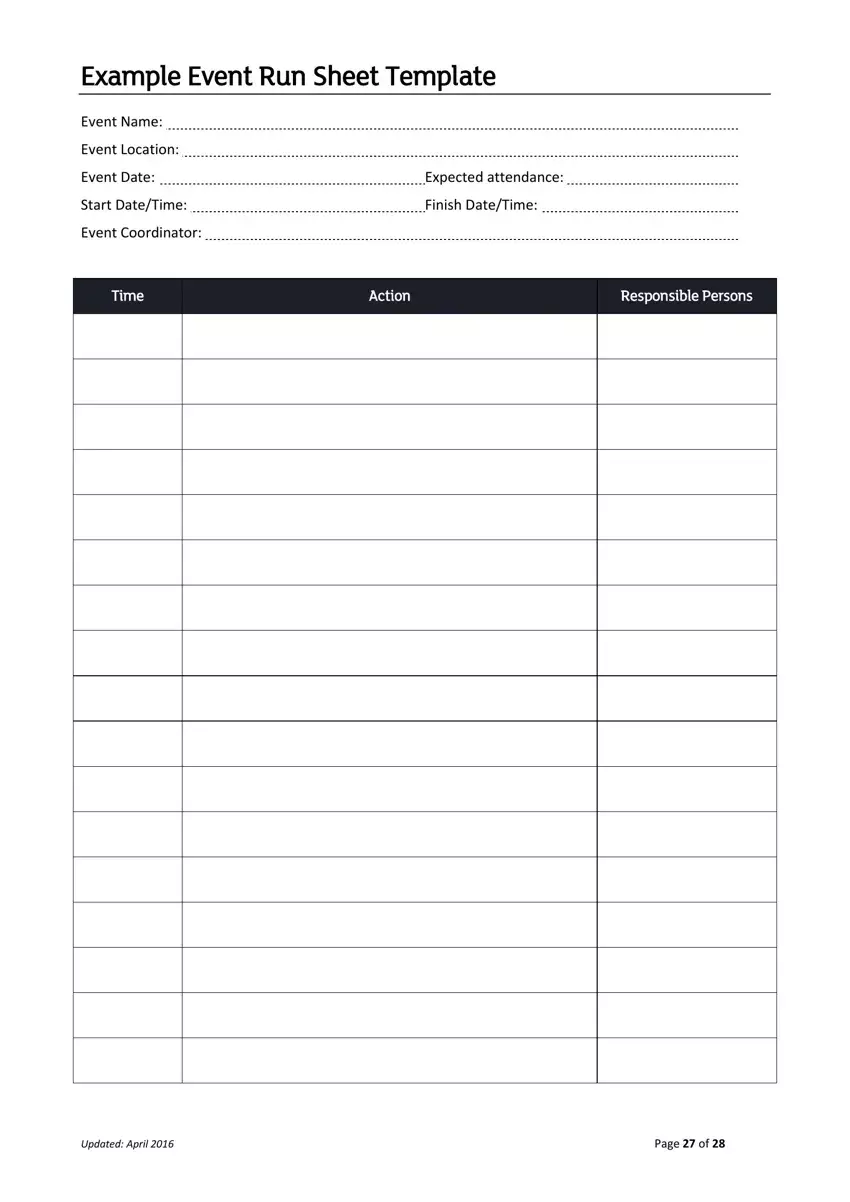
The existing format below gives a useful starting point:
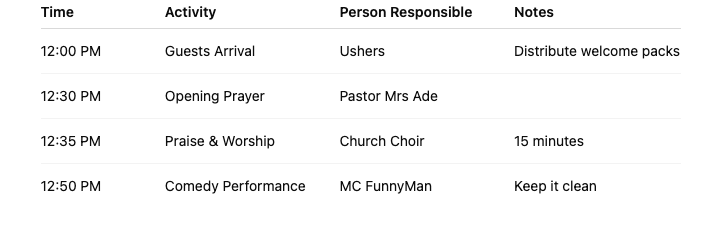
Time tells the team when something is expected to happen. Be specific enough for the timing to be useful. Activity explains what is happening at that moment. Person responsible makes it clear who is expected to ensure that moment is ready. Depending on the complexity of the event, you can also include a notes or technical column for information such as the song being played, microphone requirement, presentation file, lighting cue or where a speaker should be waiting.
The responsibility column is particularly important because "the team will handle it" often means everybody assumes somebody else is handling it.
If the cake is supposed to move beside the stage at 7:15pm, one person's name or role should be connected to that responsibility. If a video needs to play before a speaker enters, somebody should own that cue. If a performer needs to be backstage ten minutes before their set, someone should be responsible for making sure that happens.
The run sheet becomes much more powerful when it removes ambiguity.
Do Not Fill Every Minute So Tightly That One Delay Destroys Everything
A run sheet is supposed to create control, not pretend that live events happen with mathematical perfection.
Speeches can run longer than expected. A speaker can be delayed in traffic. A bride may need another few minutes before an entrance. Guests might arrive more slowly than expected. A technical issue may require a short pause.
If every activity begins the exact second the previous activity ends, one ten-minute delay can push the entire programme behind schedule.
Build realistic transitions into the document. If one panel ends at 11:30am, the next activity may not need to begin at 11:30am exactly if microphones, speakers or stage furniture have to change. At a concert, changing between performers may require technical preparation. At a wedding, moving guests between one major moment and another may take longer than it appears on paper.
The goal is not to deliberately make the programme slow. It is to recognise that transitions consume time too.
Be careful with excessive buffer time as well. Starting every section thirty minutes late because you expect guests to arrive late simply teaches the audience that your published times do not matter. A good run sheet should help the team protect the schedule while still leaving enough flexibility to respond to normal event-day changes.
The Run Sheet Only Works When the People Who Need It Actually Have It
Creating an excellent document at midnight before the event and keeping it on the planner's laptop does not help anybody.
The people responsible for major parts of the event should receive the relevant version before event day. Depending on the event, that could include the MC, stage manager, DJ, production lead, photographer, videographer, programme coordinator, speaker manager and key vendor contacts.
Not everybody necessarily needs every detail. Security personnel may need the operational timing around entrances, closing and VIP movements rather than every speech in the programme. A caterer needs to know when service is expected and how programme delays will be communicated. The photographer needs to know when important visual moments are coming so they are not outside taking detail shots when the award presentation begins.
For larger events, it also helps to review the document during a team briefing rather than assuming everyone will read and interpret it correctly by themselves.
Walk through the major moments. Confirm responsibilities. Let people ask questions while there is still time to correct misunderstandings.
This works particularly well when paired with clear event-team roles. Our guide on building an event team that delivers without unnecessary stress explains why assigning responsibility before event day makes execution much easier.
Someone Still Has to Control the Run Sheet During the Event
The document does not manage itself.
For a small event, the planner or coordinator may be the person watching the time and communicating what is coming next. For a larger conference, concert or production, a stage manager or show caller may take more direct responsibility for cues and programme movement.
Whoever controls it needs to be looking ahead rather than only reacting to what is happening at that moment.
If the keynote begins in fifteen minutes, the speaker should already be located. If the couple's entrance is next, the photographer and DJ should not discover that after the MC has already started the introduction. If a performance requires a different microphone setup, production should know before the previous act leaves the stage.
A good coordinator is often operating one or two steps ahead of the audience.
That person also needs enough authority to adjust when the schedule changes. If a speaker is late, somebody must decide whether another session moves forward. If rain interrupts an outdoor programme, the team should know who can approve a change rather than having ten people offering different solutions.
For events with significant security or crowd considerations, any major programme change should also be communicated to the relevant operational teams. Moving a headline performance earlier, for example, may change where crowds gather and when additional security is required. Our event security planning guide looks more closely at that connection between programme decisions and event safety.
Make Changes Without Letting the Document Become Useless
No matter how well you plan, the final run sheet will probably change.
A speaker cancels. The client's family adds another speech. An artist asks to swap performance positions. The caterer needs ten extra minutes. Something will move.
The problem is not that changes happen. The problem is when different people are suddenly working from different versions.
Keep one clearly identified current version. If important changes are made before the event, update the document and make sure the people affected receive the new version. Avoid having one vendor following Run Sheet Final, another using Run Sheet Final Final, while the coordinator is working from Run Sheet FINAL USE THIS ONE 3.
During the live event, not every small delay requires creating another spreadsheet. The person controlling the programme can make operational adjustments and communicate them through whatever team channel you have agreed on.
The important thing is that changes travel quickly to the people whose work depends on them.
A Good Run Sheet Makes the Event Look Easier Than It Was
Your guests probably will not leave saying, "That was an excellent run sheet."
They will say the programme flowed well. The speeches did not drag unnecessarily. The performances followed one another smoothly. Food came at the right time. The MC always seemed to know what was next and important moments happened without everyone looking confused.
That is what the run sheet is really doing.
It gives the MC, DJ, vendors, production team and coordinators the same understanding of the event before they need it. It turns a programme from a collection of activities into an actual sequence that people can execute.
It will not prevent every delay or unexpected problem. Live events are too unpredictable for that. What it does is give your team a reference point when something changes, making it much easier to adjust without losing control of everything that follows.
Before your next event, build the run sheet early enough to share it with the people who need it. Walk through it with your team, confirm responsibilities and keep one person responsible for controlling the flow once the programme starts.
And when you are ready to publish your next event, you can create your event on Shows.ng and manage the attendee-facing side while your run sheet keeps the people behind the scenes moving together.
Your guests do not need to see the run sheet. They just need to feel that everybody running the event has read it.