In this article
- Start With the Experience You Want People to Have
- In Nigeria, Weather Cannot Be an Afterthought
- Indoor Venues Give You Control, but You Still Need to Check What You Are Controlling
- Outdoor Venues Often Look Cheaper Until You Start Building the Missing Venue
- Your Guests May Decide Which Option Works Better
- Sound and Production Can Make the Decision for You
- Power Becomes a Bigger Conversation Outdoors
- Outdoor Events Need More Thought Around Security and Boundaries
- Think About Noise Before Someone Else Thinks About It for You
- Sometimes the Best Answer Is a Venue That Gives You Both
- Visit the Venue at the Time Your Event Will Actually Happen
- The Better Venue Is the One That Creates Fewer Problems for Your Particular Event
The difference between an indoor and outdoor event can be much bigger than whether there is a roof above your guests.
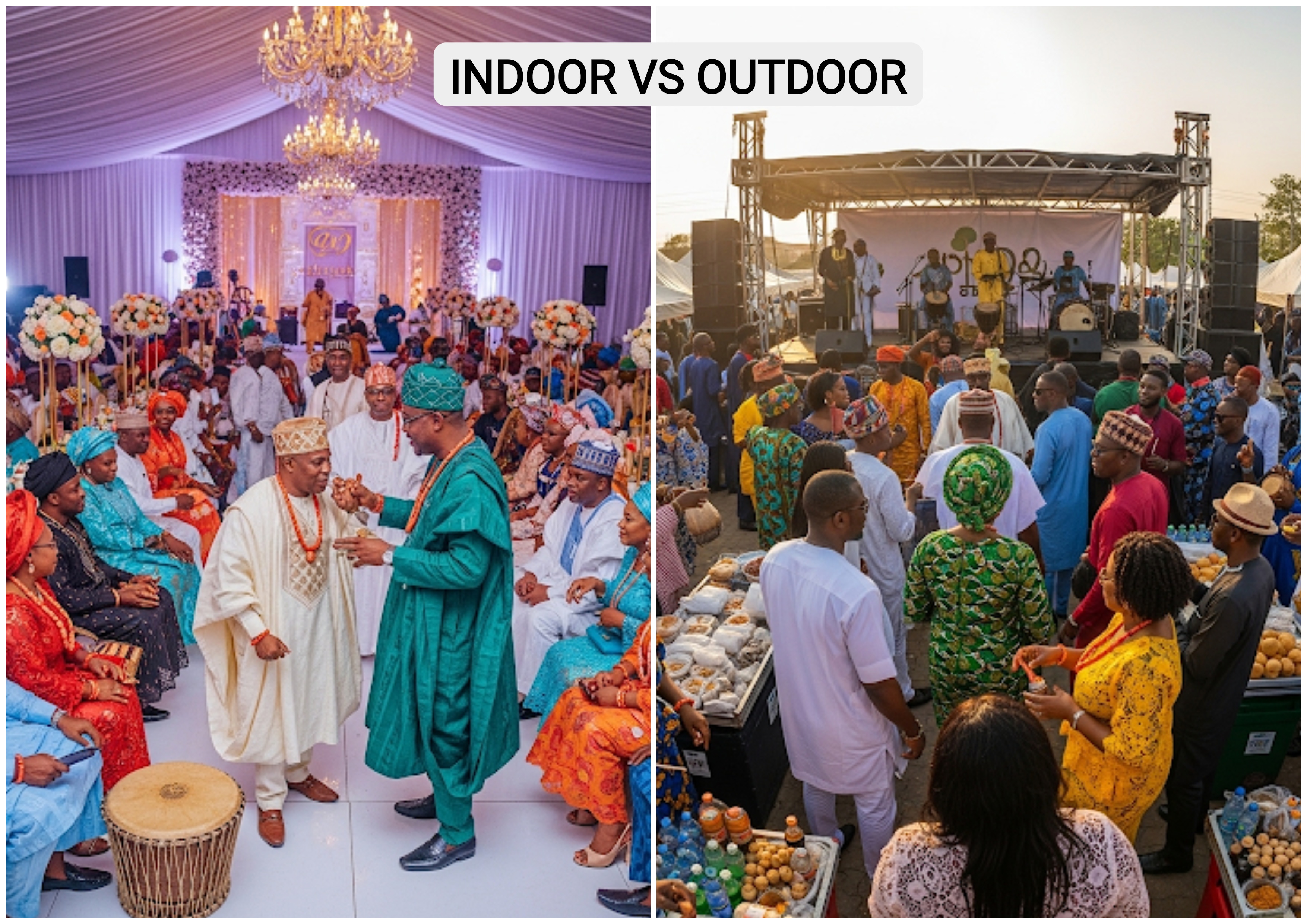
The venue affects how the event sounds, how much decoration you need, what happens if it rains, how comfortable guests feel, how much production equipment you have to bring in and even what kind of atmosphere people experience when they arrive. A garden wedding under the evening sky can feel completely different from the same wedding inside a ballroom, even with the same guests, food and music. A concert inside an enclosed venue can give you more control over sound and lighting, while an outdoor concert may create the scale and freedom the event needs.
This is why the choice between indoor and outdoor should not be made simply because one looks more beautiful on Instagram. The right answer depends on the event, audience, season, location, budget and how much uncertainty your team is prepared to manage.
Sometimes indoor is clearly the better choice. Sometimes outdoor gives you an experience a hall could never reproduce. And in many cases, the smartest venue is somewhere that gives you elements of both.
Start With the Experience You Want People to Have
Before comparing air conditioning, tents or generator costs, picture the event itself. What should it feel like when guests arrive?
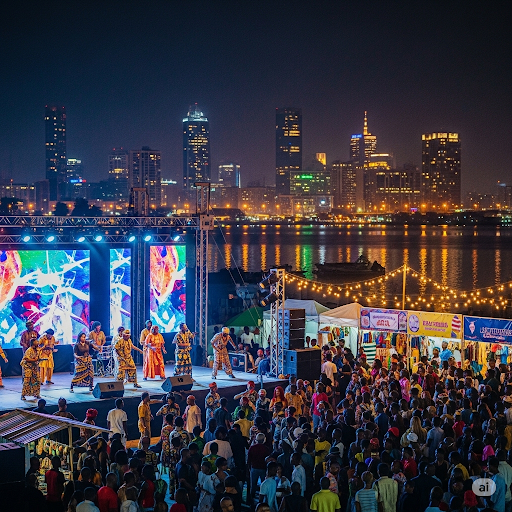
An outdoor space naturally creates a sense of openness. Gardens, beaches, rooftops and open fields can give people more room to move and can make daytime or sunset events feel relaxed without requiring a huge amount of visual production. The surroundings already contribute something to the atmosphere.
Indoor venues give you a different kind of control. You can manage the lighting, temperature and visual environment much more deliberately. This can be particularly useful when the programme depends on presentations, stage lighting, formal seating or an atmosphere that should remain consistent regardless of what is happening outside.
Neither is automatically more sophisticated.
A carefully designed outdoor dinner can feel extremely premium, while a badly chosen ballroom can feel ordinary. An intimate indoor concert can create an atmosphere that would disappear in a large field, while a festival squeezed inside a hall may feel restricted simply because the experience needs more space.
Let the nature of the event guide the venue before aesthetics take over the decision.
In Nigeria, Weather Cannot Be an Afterthought
The current version of this article is right about one thing: Nigerian weather deserves to be part of the conversation from the beginning.
The problem with planning an outdoor event is not simply that rain can fall. It is everything rain affects once it arrives. The ground may become difficult to use, electrical equipment needs protection, guests need somewhere to move, decorations can be damaged and vehicle access may change very quickly.
Even without rain, heat can make an afternoon event uncomfortable. A beautiful open field at 1pm may look perfect during a site visit and feel completely different once hundreds of guests are sitting there in formal clothing. Wind can create another set of problems for banners, lightweight decorations, projection screens and temporary structures.
This does not mean outdoor events should be avoided during the rainy season or hot months. It means the weather plan has to be part of the venue plan.
If the event cannot reasonably continue in bad weather, ask yourself what the alternative is before taking deposits. Can guests move into a covered section? Can you install a suitable marquee? Is there another space on the property? Would postponement be possible, or would that create a serious financial problem?
The answer should exist before the first weather forecast starts worrying you.
Indoor Venues Give You Control, but You Still Need to Check What You Are Controlling
Indoor venues are often attractive because several environmental problems have already been reduced. You have a roof, defined entrances, established toilets and, in many cases, air conditioning, lighting and power infrastructure.
That convenience can be valuable, but do not assume every indoor venue performs equally well.
A hall may technically have air conditioning but struggle once the room fills with several hundred people. Power may be available, but not enough for the production equipment your concert or conference requires. A venue may look spacious before decoration and become surprisingly tight once a stage, tables, catering stations and camera equipment are installed.
Sound behaves differently indoors too. An enclosed room can help contain music, but hard surfaces and poor acoustics can create echoes that make speeches difficult to understand. If the event depends heavily on sound, your technical team should inspect the venue rather than assuming the fact that it has speakers means everything is sorted.
Indoor spaces give planners more control only when the infrastructure can actually support the event being planned.
Outdoor Venues Often Look Cheaper Until You Start Building the Missing Venue
An open field, private compound or garden may have a lower rental fee than a fully equipped event centre, which can make outdoor planning look immediately cheaper.
Then the other costs begin appearing.
You may need to create shade, seating, lighting, toilets, power, perimeter security, walkways and covered areas. Caterers may need temporary service infrastructure. Production equipment may require additional protection. If the event continues after dark, areas that looked perfectly usable during the afternoon suddenly need proper lighting.
That does not mean outdoor events are always more expensive. A simple garden gathering may require very little additional setup, while a premium hotel ballroom can take a large portion of the budget before decoration begins.
The important comparison is the **finished cost**, not the rental fee.
Ask both venues exactly what is included. If an indoor venue provides chairs, tables, cooling, power and basic lighting, calculate what those same requirements would cost outdoors. If the outdoor venue gives you enough existing infrastructure that only a small amount needs to be added, the numbers may move in the other direction.
Our guide on how to choose the right venue for an event goes deeper into comparing capacity, location and what is actually included before you pay a deposit.
Your Guests May Decide Which Option Works Better
The same venue can feel very different depending on who is attending.
A younger audience at a casual music event may happily spend several hours standing outdoors, especially if the event is happening in the evening and movement is part of the experience. The same setup could be uncomfortable for an event where many guests are elderly, formally dressed or expected to sit through a long programme.
Children introduce another consideration because open spaces give them room to move but can make supervision more complicated. Corporate audiences may appreciate the reliability and controlled environment of an indoor venue, particularly where laptops, presentations and extended sessions are involved.
Accessibility should be part of the decision too. Outdoor venues can have uneven surfaces, grass, sand or long walking distances that become difficult for guests with limited mobility. Indoor buildings can have their own problems if the event space is reached only by stairs or if lifts are inadequate for the expected crowd.
Think about the people who will actually attend, not only the photograph you want from the venue.
This is especially important for mixed-age events. Our guide on planning events for different age groups explains why comfort, attention span and mobility should influence event decisions rather than treating every guest the same way.
Sound and Production Can Make the Decision for You
Some events are much more technically demanding than others.
A conference that relies on presentations, multiple screens and clear speech may benefit from the controlled environment of a suitable indoor venue. A concert may work indoors or outdoors, but the sound system and production design will be very different in each environment.
Outdoors, sound is not contained by walls, which means the system needs to cover the audience area properly without creating unnecessary disturbance for surrounding communities. Wind and distance can also affect how sound behaves. For concerts and festivals, your production company should be involved before the venue is confirmed rather than after the organiser has already paid.
Indoor venues have their own acoustic challenges. Large halls with reflective surfaces can produce echoes, and smaller rooms can become unpleasant when the sound system is too powerful for the space.
Lighting follows a similar pattern. Indoors, you can control the visual environment from the moment the event begins. Outdoors during daylight, stage lighting may have far less visual impact until evening. If the event depends on projection, LED screens or dramatic lighting, think about what time of day the important programme moments happen.
The venue and production should be designed together. Trying to force an indoor production plan into an outdoor field at the last minute is usually where costs begin growing.
Power Becomes a Bigger Conversation Outdoors
The existing article also highlights power supply, and this remains one of the practical differences organisers should examine carefully.
Many established indoor venues already have a power arrangement, although you should still confirm the capacity and backup rather than simply assuming the generator can handle everything your vendors bring.
For outdoor events, you may be responsible for creating the power infrastructure yourself.
The sound system needs electricity. Lighting needs electricity. Caterers may need power. Ticket-scanning devices, screens, refrigeration and other equipment may all be part of the load. Generators need to be positioned safely and far enough from guests that noise and fumes do not become part of the event experience.
Your technical team should calculate what is required rather than everybody arriving with equipment and plugging into whatever extension cable appears available.
A backup plan matters here too. If one power source fails, determine which parts of the event absolutely need to remain running and how quickly the backup can take over.
Outdoor Events Need More Thought Around Security and Boundaries
An indoor venue usually gives security a defined building to control. There are doors, walls and clearer distinctions between public areas and restricted areas.
An open field, garden or beachfront may have much less obvious boundaries.
That affects ticket control, guest movement and access to backstage or vendor areas. If people can approach the event from several directions, your security team needs to understand which entrances are legitimate and how the rest of the perimeter will be managed.
Lighting outside the main event area matters as well. Guests still need to reach parking, toilets and exits safely after dark.
Indoor events are not automatically safer, of course. A crowded hall with blocked exits or poor crowd movement can become dangerous very quickly. The difference is simply that outdoor spaces may require you to build more of the access-control environment yourself.
Our event security planning guide covers entrances, emergency routes, crowd movement and staff responsibilities in more detail.
Think About Noise Before Someone Else Thinks About It for You
Outdoor music carries.
A rooftop party can be enjoyable for the people attending and extremely irritating for residents several streets away. The same applies to open-field concerts, garden celebrations and residential events.
Before committing to an outdoor venue, ask about operating hours and noise restrictions. If the location regularly hosts events, the management should be able to explain what is permitted. If you are converting a private property or unusual space into an event venue for the night, you may need to investigate those restrictions yourself.
Indoor venues can provide more sound containment, although poorly insulated buildings can still create problems for neighbours.
This becomes particularly important when your programme is likely to continue late into the night. A venue that looks perfect at 3pm may be a terrible choice at midnight if local restrictions require the music to stop hours before your planned closing time.
Sometimes the Best Answer Is a Venue That Gives You Both
The indoor-versus-outdoor decision does not always have to be absolute.
Some of the most flexible venues combine an indoor space with a garden, terrace, courtyard or covered outdoor area. That can allow different parts of the event to use different environments.
A wedding ceremony might take place outside before the reception moves indoors. A conference can use indoor rooms for presentations and an outdoor terrace for networking. A brand event might hold the main programme in a controlled interior space while food, entertainment or product experiences happen outside.
This can also create a natural backup plan. If rain affects the outdoor portion, the event may already have somewhere suitable to move.
Hybrid spaces can cost more, but for events where weather uncertainty is a major concern, that flexibility may be worth more than trying to rescue an entirely outdoor plan at the last minute.
If you want to explore alternatives beyond conventional halls, our article on unique event venue ideas in Nigeria looks at rooftops, gardens, waterfronts, industrial spaces, theatres and other settings that can change the character of an event.
Visit the Venue at the Time Your Event Will Actually Happen
A venue inspection at 11am can tell you very little about what the same place feels like at 8pm.
If you are planning an evening outdoor event, visit around the time guests will be there if possible. See how dark the surroundings become, how traffic behaves and whether mosquitoes suddenly become an unofficial part of the guest list.
For an indoor venue, consider what happens when the building is busy rather than empty. Ask about cooling at full capacity, generator performance and how other events happening in the same property might affect parking or noise.
Pay attention to practical movement too. Walk from the parking area to the event space. Find the toilets. Locate the exits. Imagine caterers and production teams trying to bring in equipment. Ask where ride-hailing vehicles can stop without blocking the entrance.
A venue photographs itself during an inspection. Your job is to imagine it under pressure.
The Better Venue Is the One That Creates Fewer Problems for Your Particular Event
There is no general winner between indoor and outdoor venues.
Indoor spaces usually give you stronger control over weather, temperature, power, sound and access. Outdoor venues can offer space, natural scenery and an atmosphere that is difficult to reproduce inside a hall. Either option can be comfortable, expensive, affordable, beautiful or frustrating depending on the venue and how well it matches the event.
Instead of asking which type is better, ask what your event cannot afford to compromise.
If weather disruption would destroy the programme, indoor or strongly covered options deserve serious consideration. If the experience depends on open space and movement, forcing it into a hall may solve one problem while creating several others. If older guests are central to the audience, comfort may carry more weight. If production is technically complex, involve the technical team before the venue decision becomes final.
Most importantly, calculate the whole event around the venue rather than judging it only by the rental price or photographs.
Once the location is confirmed and you are ready to take the event public, you can create your event on Shows.ng and give attendees a clear place to find the date, venue details and ticket or registration information.
The best venue is not the one with a roof or the one under the sky. It is the one that lets your event work the way it is supposed to.